
Decks
Custom Deck Builder in Middletown, NJ: How the Job Goes
8 min read
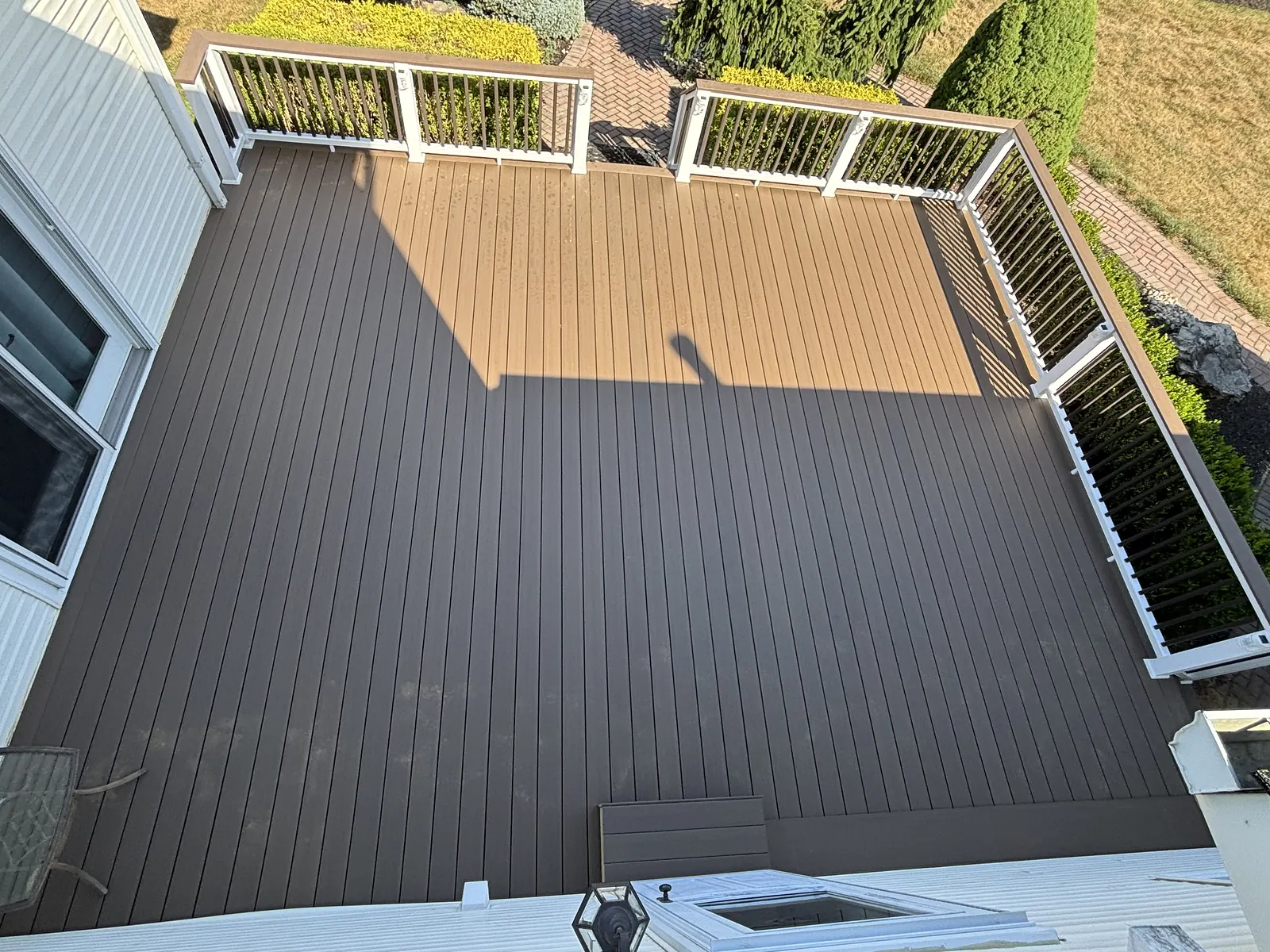
If you are hiring a custom deck builder in Middletown, NJ, the part that decides how long your deck lasts happens before a single board goes down. Footings, the ledger connection, and the hardware do the work. The decking you pick is the part you see.
We are Ronnie and Tyler Thompson, a father and son crew. We build decks all over Middletown, from Leonardo and Port Monmouth to the streets in North Middletown. Here is how a deck job runs, what slows one down, and what to ask before you sign anything.
Does a deck in Middletown need a permit?
Yes. A new deck in Middletown needs a construction permit from the township, and the work gets inspected along the way.
The town wants a plan showing the size, the post layout, the framing sizes, how the deck attaches to the house, and where it sits on the lot. Setbacks matter, so a deck that crowds a property line can get kicked back before it starts.
We file the applications and meet the inspectors ourselves. You are not the one taking a day off work to stand in the yard with a tape measure. Expect the paperwork side to take a few weeks depending on how busy the office is, and plan your summer around that, not around the build week.
How deep do deck footings go in New Jersey?
Footings have to sit below the frost line, which around here means digging down roughly three feet. Shallow footings heave when the ground freezes and thaws, and a heaved deck pulls away from the house.
The soil matters too. Closer to the bay you hit sand, and sand needs a wider footing to spread the load. Farther inland you find heavier soil that holds better. We dig, we look at what is down there, and we size the footing for what we find instead of using the same hole everywhere.
We set post bases on top of the concrete so the bottom of the post never sits in a puddle. End grain sitting in water is the fastest way to rot a post from the inside.
What salt air does to a deck near the bay
Salt air eats cheap metal. On a deck within sight of Sandy Hook Bay, the hardware fails long before the lumber does.
We use hot dipped galvanized or stainless fasteners, hangers, and bolts, because plain coated screws will bleed rust stains down the boards in a season or two. Where the deck ties into the house, the ledger gets flashed so water runs out instead of sitting against the rim joist.
We also leave the deck room to drain. Gaps between boards, gaps behind the ledger flashing, and no trapped ledge where leaves can pack in and hold water against the wood.
Wood or composite decking, how to decide
Pick wood if you want the lowest price now and you do not mind cleaning and sealing it. Pick composite if you would rather spend more once and wash it off every spring.
Both work here. The framing underneath is pressure treated lumber either way, so the choice is really about the walking surface and how much maintenance you want on your calendar.
| What matters | Pressure treated wood | Composite |
|---|---|---|
| Up front cost | Lower | Higher |
| Yearly upkeep | Clean, then stain or seal | Wash it down |
| Salt air and sun | Grays, can cup or split without upkeep | Holds color and shape well |
| Bare feet in August | Stays cooler in light colors | Dark boards get hot in full sun |
| Look | Real grain, stain any color | Set colors and grain patterns |
| Repairs | Swap a board, easy to match | Match the line and color you bought |
Sizing a deck for how you really use it
Most people build a deck too small in the plan and too big in the budget. Measure your furniture first, then draw the deck around it.
A table with chairs needs room to slide back without somebody falling off the edge. A grill needs a spot out of the traffic path and away from siding and railing. Stairs should land where people actually walk into the yard, not wherever the framing happened to end.
Railing height and baluster spacing are set by code, not by taste. Guards on a residential deck run three feet high, and the gaps have to be tight enough that a small child cannot slip through. We build to that, then pick a railing style that suits the house.
The order we build a deck in
Every deck we build follows the same sequence, so you always know what day you are on.
- 01We walk the yard with you, measure, and talk about how you plan to use the space.
- 02We put the design and a written scope on paper, with the materials named.
- 03We file the permit application and wait for approval.
- 04We lay out the posts, dig the footings, and pour.
- 05The inspector checks the footings before anything gets covered.
- 06We set posts and beams, attach and flash the ledger, and frame the deck.
- 07Framing gets inspected, then decking, stairs, and railing go on.
- 08Final inspection, then we walk the finished deck with you and clean up.
Questions to ask any deck builder before you sign
Ask these five and you will learn more than any brochure will tell you.
- What is your New Jersey home improvement contractor license number, and are you insured?
- Who is on my property every day, you or a sub you have not met?
- Are you pulling the permit, or are you asking me to pull it as the homeowner?
- What hardware are you using where the deck meets the house, and how is it flashed?
- What is in writing before work starts, and how do changes get priced?
What can slow your deck down
Two things stall decks here: permit timing and weather. Neither one is a surprise if you plan for them.
If you want to be eating outside by Memorial Day, start the conversation in late winter. Footings can be dug in cold weather, but a stretch of rain turns the yard to soup and pouring concrete into a wet hole is not something we will do.
Material choice can add time too. Standard pressure treated lumber is usually on the shelf. A specific composite line in a specific color may have to be ordered, so we lock that in before the permit comes back rather than after.
Questions we get asked
- How long does it take to build a deck in Middletown?
- The build itself is usually a matter of days to a couple of weeks depending on size, stairs, and railing. The permit review before that is the long pole, and it runs on the township's schedule, not ours. Start the process well before the season you want to use the deck.
- Can you attach a deck to a house with vinyl siding?
- Yes, but the siding comes off where the ledger lands. The ledger has to bolt to solid framing, not to the siding, and then it gets flashed so water sheds away from the house. Anyone who screws a ledger over siding is setting you up for rot behind the wall.
- Do you build decks in towns besides Middletown?
- We do. We build in Union Beach, Hazlet, Holmdel, Aberdeen, Colts Neck, and Atlantic Highlands as well, all in Monmouth County. Each town runs its own permit office, and we handle the filing in whichever one you are in.
- Can you replace just the decking and keep my frame?
- Sometimes. We pull a few boards and look at the joists, the ledger, and the posts first. If the frame is sound and the hardware is not rusted through, resurfacing is a real option. If the bones are gone, new boards on a bad frame just hide the problem.
- What does a deck cost?
- It depends on size, height off the ground, stairs, railing, and material, and any number given over the phone before seeing the yard is a guess. We come out, measure, and put a written estimate in your hands at no charge.
Want us to take a look?
Tell us what you have going on. Ronnie will come out, look at the space, and put a written estimate in your hands at no charge.